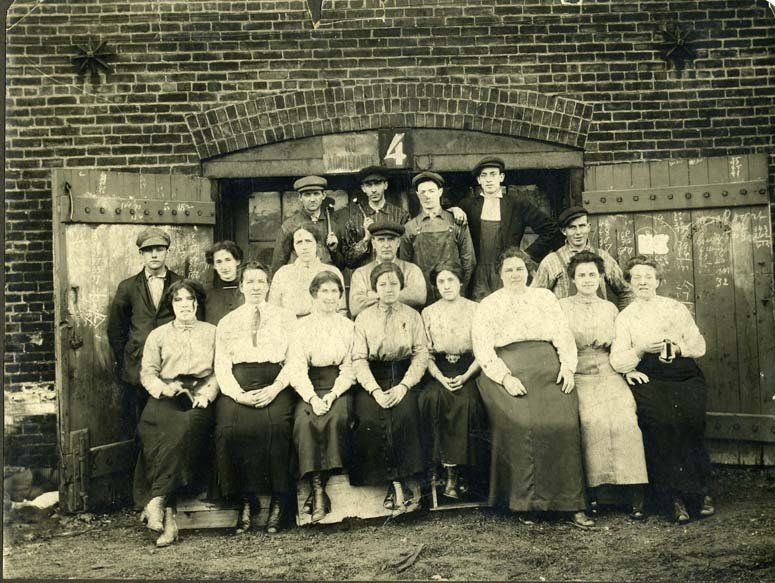
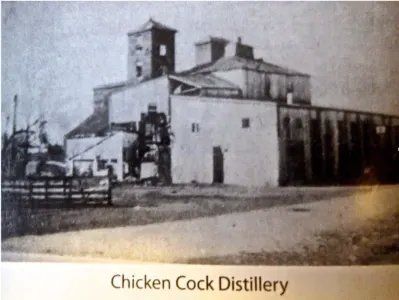
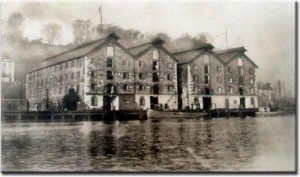
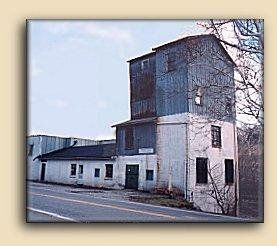
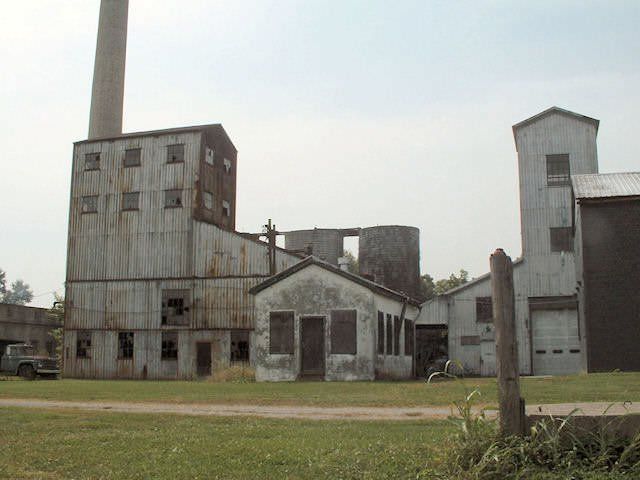
The Petersburg Steam Mill Company was established in 1817 by a North Carolinian named John James Flournoy. The business was transformed into a distillery when two Virginian brothers purchased it in 1833. The Petersburg Distillery was the only distillery in Boone County and at one time the largest in the state of Kentucky. In 1860, the Petersburg Distillery produced 1.125 million gallons of whiskey. Despite the exuberant Federal liquor tax of the Civil War, the distillery continued to do well and, in 1874, was purchased by the Cincinnati firm of Freiburg and Workum. They expanded production so that by 1897 the annual capacity had ballooned to 4 million gallons. The success was not to last, as it was sold in 1899 to a company who sold off all the bonded whiskey and eventually dismantled the buildings. Several buildings in town were built from bricks that were once part of the distillery, including Odd Fellows Hall, Petersburg Baptist Church, and the Petersburg Jail.
Lewis Loder, a Petersburg resident who was bookkeeper and clerk at the Petersburg Distillery and also Justice of the Peace, documented almost 50 years of operations at the distillery and daily life in Petersburg. Lewis was born in Pennsylvania but came to Boone County with his father and siblings around 1839. On March 2, 1849, Lewis married Julia Goodridge Hayden who was widowed and caring for a son from her first marriage. They moved into a two-story home known as White Hall on the corner of Tanner and Front Streets, where they ran a tavern and inn. In 1857, Loder was elected Justice of the Peace and began keeping his daily diaries that would continue until 1904. He gave a great deal of information about the people who lived in Petersburg and the surrounding areas. He recorded the temperature and weather conditions, births, marriages and deaths, happenings at the distillery, and everyday events such as picnics or other events.
In 1894, at the age of 75, Lewis moved to Constance to live with his son Leon. He continued to write in his diary until 1903 when a new hand takes over writing, most likely Leon. The last entry in the diary is on December 15, 1904. Lewis died at the home of his son on March 16, 1905. In his obituary it states he had a long illness and that he was to be interred in Petersburg but there is no marker for him.
As you drive down Kentucky 20 into quiet Petersburg, Kentucky, it is hard to believe that Kentucky’s largest distillery once dominated the southern half of the town. For over a century, the Petersburg Distillery, by far Boone County‘s leading industry, sat along the banks of the Ohio River in Petersburg.
The early development of Petersburg was closely tied to a North Carolinian named John James Flournoy who, in 1817, platted the town and established the Petersburg Steam Mill Company. Flournoy’s mill was transformed into an industrial power by a Virginian named William Snyder who came to Petersburg in 1833 with his brother John. William Snyder developed the Petersburg Distillery into an industrial giant: in 1860, the distillery produced a staggering 1.125 million gallons of whiskey. Despite the distillery’s success, Snyder was heavily in debt. In 1862, his assets were seized and auctioned by the sheriff at the courthouse.
The distillery weathered the exorbitant Federal liquor taxes of the Civil War under subsequent owner Colonel William Appleton. Near the end of the war, Appleton sold most of his interest to Petersburg’s Joseph C. Jenkins and James Gaff of Aurora, Indiana. Jenkins was a successful stock breeder whose glorious home, “Prospect Farm,” still commands the hill above town. Gaff was a distiller whose brother Thomas Gaff’s 1855 home “Hillforest” is a National Historic Landmark. The trio had some success, but by 1874 each had sold their interest in the distillery to the Cincinnati firm of Freiburg & Workum.
Cincinnati’s whiskey industry of the late 19th Century was marked by expansion and agglomeration and Freiburg & Workum were the biggest fish in a very large pond. By 1880, the distillery was making more whiskey than any other distillery in the state of Kentucky. That year, the distillery was worth $250,000 and produced 975,820 gallons of whiskey. By comparison, the nine distilleries in famed Bourbon County produced only 433,263 gallons of whiskey. By 1897 the Petersburg Distillery’s annual capacity had ballooned to 4 million gallons. The daily capacity of the stills (12,000 gallons) was more than 14 times that of the average 1890s Kentucky distillery and comparable to the output of the massive distilleries of Peoria, Illinois
The Petersburg Distillery’s success would not last into the 20th Century. Freiburg & Workum sold the distillery in 1899 to a company that sold off all the bonded whiskey and eventually dismantled the buildings. By 1919, little of the once proud industry remained. Today, the distillery is an archaeological site with remnants of stone and brick foundations and walls. Three buildings from the complex survive, including the ca. 1870 Cooperage, ca. 1850 Scales Office, and 1885 Superintendent’s House. Other buildings in town are built from distillery brick, including several houses, the 1913 Odd Fellows Hall, the 1916 Petersburg Baptist Church and the tiny 1916 Petersburg Jail.