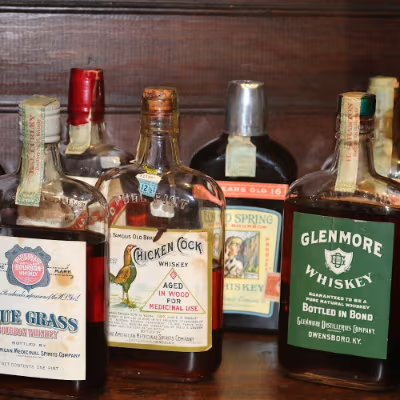
The Chicken Cock Distillery RD #14, 7th District Bourbon County, KY

Jerry Daniels • October 31, 2019

Share this article

The Chicken Cock distillery was established in 1855 by a “Mr Foley” (Cecil 1999). It was located on Maysville Pike, 1/2-mile east of Paris.According to Cecil, the distillery passed through several hands between 1855 and 1882, including J A Miller, Wm Tarr, G A White and C Alexander.Insurance underwriter records compiled in 1892 suggest that the plant was large. The distillery itself was brick with a metal or slate roof. The distillery property included a grain warehouse, a corn house, a cattle barn, and a cooper shop. There were six Bonded and one Free warehouses, all brick with metal or slate roofs. Locations are follows:


Warehouse A, B, and C — adjoining and 50 ft south of the still.
Warehouse D — adjoining A, B and C, located 155 ft south.
Warehouse E — 40 ft north of the still.
Warehouse F — 170 ft east of the still.
Warehouse F — a Free warehouse located on Church St near the depot.At that time, the distillery was being operated by G G White Co., formerly White & Alexander.


Chicken Cock Whiskey was first established in 1856 in Paris… Paris, Kentucky, that is; a town tucked away in the heart of Bourbon County. One hundred sixty two years ago, James A. Miller built a distillery and started making a type of whiskey unique to the Bluegrass region, bourbon. He named his whiskey Chicken Cock.


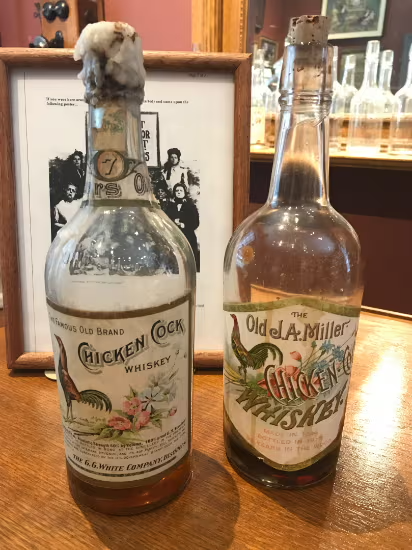
Two vintage liquor bottles on a wooden table, one with a cork and one labeled Old L. Miller Whiskey.

Chicken Cock’s Rapid Growth

Just a few years after Chicken Cock’s founding, James A. Miller passed. All he left behind were a few thousand dollars to a trusted clerk at the distillery and a high-quality whiskey brand that was still in its infancy. The clerk, a man named George G. White, would be the man to carry on Chicken Cock Whiskey’s legacy and make it into what we know today.


Together, White and a few partners were able to buy the distillery and continue production. Soon, the Chicken Cock Distillery was mashing up to 400 bushels of grain per day. At this rate, 9,000 barrels of Chicken Cock Whiskey were filled annually.


Around 1880, White changed the distillery’s name to the G.G. White Distillery. The name might have changed, but he didn’t forget who created this iconic bourbon. White paid homage to James A. Miller by renaming the spirit The Old J.A. Miller Chicken Cock.


By 1886, White had increased the mashing capacity to 600 bushels per day. This warranted the creation of six warehouses, each capable of storing up to 32,000 barrels.

America was starting to notice.

Growth, Prosperity, and Imitation

The G.G. White Distillery continued to grow in size and production capabilities. Eventually, the distillery grounds included a cooperage, cattle barn, and grain bins. Hundreds of heads of cattle and hogs were fed the spent grain mash, or slop. The cooperage crafted handmade wooden barrels for the bourbon to age in, while White continued to prove to be a keen and determined businessman.

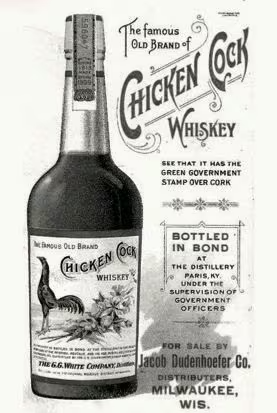
Vintage black-and-white Chickena Cock Whiskey advertisement with bottle, rooster, and bold text.

Chicken Cock Goes West

Kentucky’s proximity to the Mississippi River granted access to distribute bourbon to every port down to New Orleans. From there, it could go anywhere in the world. Through aggressive advertising, J.A. Miller Chicken Cock rose in sales and expanded its reach across the country. They forged relationships with a network of distributors stretching from the Midwest to up the East Coast.


J.A. Miller Chicken Cock even made its way out west, all the way to California. An article published in California praised Chicken Cock Whiskey as a favorite.


Large dealers were purchasing lots from 50 to 1500 barrels at a time. In a land that loves its whiskey, Chicken Cock was making an impact.

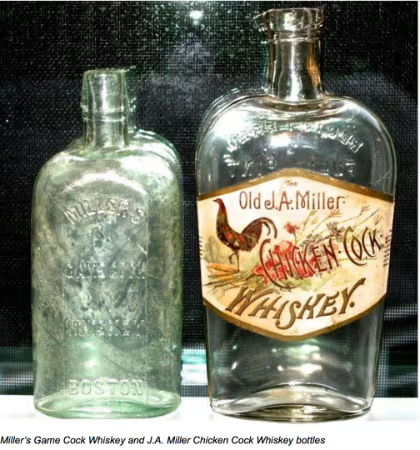
Two vintage whiskey bottles, one labeled Old J.A. Miller Chicken Cock Whiskey with a rooster illustration

Catching a Copycat

Chicken Cock Whiskey became so popular that in 1889 White noticed signs of an imitation brand. Miller’s Game Cock Bourbon, out of Boston, Massachusetts, copied everything from the name to the label design of J.A. Miller Chicken Cock. And while imitation is the sincerest form of flattery, something had to be done.

In order to protect the name of his whiskey, White filed a trademark infringement suit. The Circuit Court of Massachusetts ruled in their favor, stating:


“This whiskey for more than 30 years has always been known in the trade as Miller’s Chicken Cock Whiskey,” or “Chicken Cock Whiskey,” and has been noted for its high grade and uniform excellence; and this mark has been stamped on every barrel or package of the whiskey made or sold by Miller or his successor in the business.”

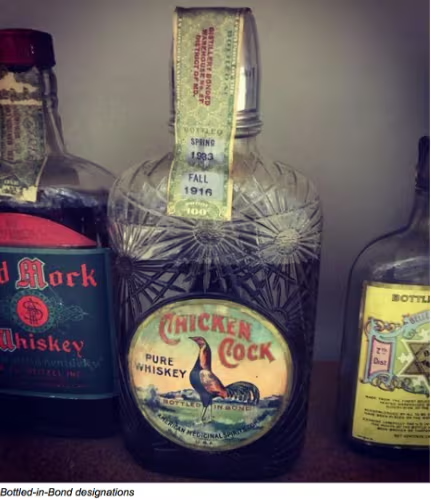
Three vintage whiskey bottles on a shelf, including a central “Chicken Cock” bottle and a “Red Mark Whiskey” bottle.

Increasing Legitimacy in the Bourbon Industry

States with strong grain economies, such as Kentucky, Tennessee, Maryland, and Pennsylvania, particularly thrived during this time of rapid expansion. As whiskey continued to gain popularity, distilleries began popping up across the nation. Unfortunately, not all of these makers were in it for the craftsmanship of distilling spirits. Dishonest manufacturers added things like prune juice, other spirits, and even tobacco spit to their product and sold it as bourbon. Actions like this tarnished the whiskey industry, making it hard to decipher what was true bourbon and what was not.


Distilleries sought a way to protect the bourbon name and add legitimacy to the industry. They needed some form of federal quality regulation. Bourbon distilleries lobbied congress and successfully passed the Bottled-in-Bond Act of 1897. The act put in place specific regulations that ensured that only quality bourbon was being sold as such. Bourbon was now required to be stored in government-regulated and supervised warehouses, be aged a minimum of four years, poured at 100 proof, and be a product of a single distillery. By following the government regulations, distilleries could earn the “bottled-in-bond” stamp of approval signifying a high-quality, pure product.

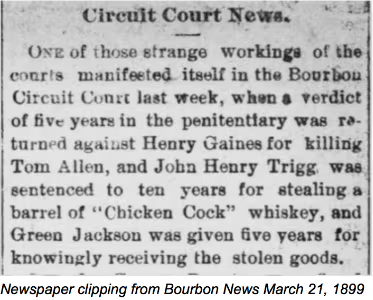
Newspaper clipping about Bourbon Circuit Court convictions for murder, theft, and receiving stolen goods

Whiskey Worth More Than Murder

Bottled-in-bond bourbon wasn’t cheap, and it turns out that stolen whiskey was worth more than murder. In 1899, Bourbon News reported that Henry Gaines was sentenced to five years for the murder of Tom Allen. However, John Henry Trigg received 10 years for stealing a barrel of Chicken Cock Whiskey. Five years went to the man who knowingly bought the stolen whiskey.

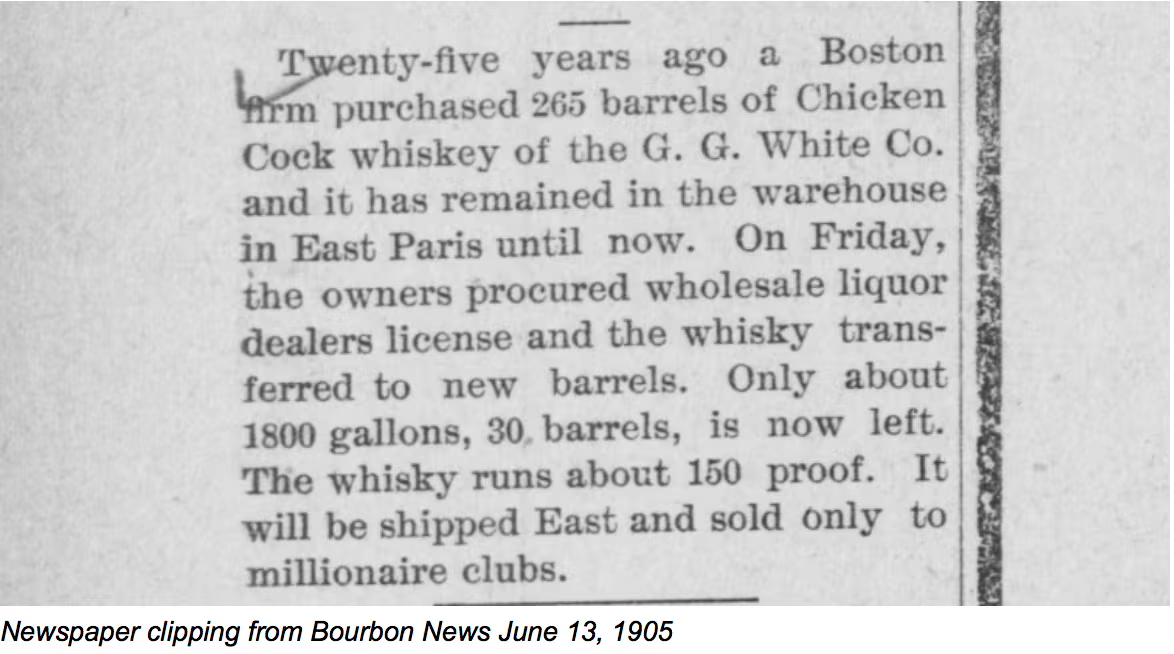
Newspaper clipping with a faded article about Chicago beer barrels in East Prairie, white text on gray paper

Chicken Cock Releases Premium Aged Bourbons

Having been a prominent whiskey distillery in the South for roughly 50 years, Chicken Cock had been around long enough to produce premium whiskey that had been aged for decades. In 1905, Bourbon News reported that a run of Chicken Cock Whiskey aged for 25 years was now available. This run, however, was for society’s elite and sold exclusively to “millionaire clubs.” That is, until prohibition.

Prohibition and the Cotton Club

Prohibition hit America in 1920. The 18th amendment deemed the manufacture and sale of alcohol to be forbidden by law. Large distilleries were able to utilize a legal loophole to sell their spirits for “medicinal purposes” at pharmacies, but this process was expensive. Many smaller distilleries were unable to afford the prescription labels that were required to take this route.


These new laws brought many mom-and-pop spirits companies to a halt, including G.G. White Distillery and its J.A. Miller Chicken Cock Whiskey. Like many small operations, a larger foreign conglomerate bought them out. Distillers Corporation Limited, of Montreal, Canada, purchased legal rights to the Chicken Cock name and began production outside of the U.S.

New Owner, Same Chicken Cock

With longer transport routes, Distillers Corporation Limited did away with the identifiable J.A. Miller Chicken Cock Whiskey glass bottles and opted for tin cans filled with Canadian Rye. The packaging and liquid may have been different, but Chicken Cock was still making its mark in whiskey lore.

Chicken Cock whiskey bottle and tin can on a shelf, with vintage labels and rooster logo

Chicken Cock and the Cotton Club

As a result of prohibition, smuggling alcohol into America became an industry of its own. The illegal sale of bootlegged alcohol ran rampant, and nowhere more so than in speakeasies. Speakeasies offered refreshment, exclusivity, music, and secrecy. It wasn’t long before Chicken Cock found its way into one of New York City’s most popular nightclubs. The Cotton Club, located in Harlem at 142nd St. and Lenox Avenue, featured Chicken Cock as their house whiskey.

Black-and-white street scene of the Cotton Club nightclub with neon sign and parked cars out front

Making an Impression

The Cotton Club was one of the most famous speakeasies in history and hosted some of the jazz era’s most prominent musicians. Louis Armstrong, Count Basie, and Fats Waller all took their turn performing at this iconic 1920s hideout. Duke Ellington and his orchestra regularly performed on the Cotton Club’s stage, which eventually launched him into national fame and international stardom.


As the house whiskey, Ellington recalls Chicken Cock as “good whiskey,” and even reminisces about the whiskey that came sealed in a can in his memoir, Music is My Mistress.


During the prohibition period, you could always buy good whiskey from somebody in the Cotton Club. They used to have what they called Chicken Cock. It was a bottle in a can, and the can was sealed. It cost something like ten to fourteen dollars a pint ($140+ in today’s dollars).

—Excerpt from Music Is My Mistress, Duke Ellington


Prohibition didn’t last forever, though, and when the 21st amendment was passed, distilleries were hopeful for whiskey’s future.

Assorted vintage liquor bottles on a wooden shelf, including Glenmore whiskey and Chicken Cock bourbon labels

Post-Prohibition

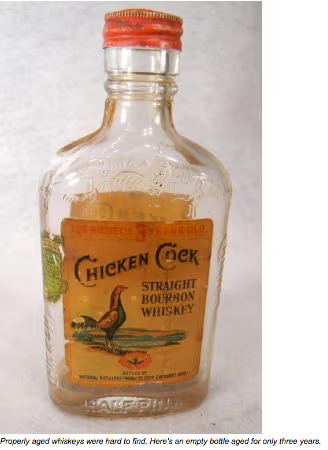
Toward the end of prohibition, Chicken Cock Whiskey changed hands again. The American Medicinal Spirits Company, owned by National Distillers Products Corporation, trademarked the brand and sold it for medicinal use. After the 21st amendment passed and Prohibition came to an end, there was a push for the revival of Chicken Cock Whiskey. National Distillers Products Corp. poured efforts into advertising attempting to bring it back to its pre-prohibition glory.


But it wasn’t that easy.

Bottle of Chicken Cock Straight Bourbon Whiskey with orange label and red cap on a white background

Bourbon Faces Challenges

Prohibition outlawed the manufacturing of intoxicating beverages in the United States. This means that for thirteen years, while prohibition laws were intact, there was little to no whiskey being distilled in the U.S.

For several years after the end of Prohibition, whiskeys were either barely aged or replaced by unaged bourbon. It was hard (if impossible) to procure quality aged liquors for the market. Whiskeys quickly fell out of favor for lighter, unaged spirits.


Gradually, the once coveted Chicken Cock Whiskey brand started fading away, until dying off in the 1950s.

Chicken Cock Whiskey’s Revival

Chicken Cock’s fortunes changed in 2011 when spirits entrepreneur Matti Anttila discovered the brand while researching the early days of distilling in the United States. A mere memory at that point, he decided that The Famous Old Brand needed to be brought back from the dead. So he started buying the best aged bourbon he could find and exploring the market for old relics of the brand’s glory days.

Recent Posts

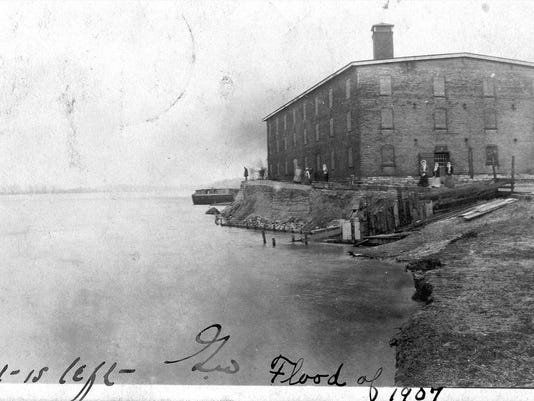
Historic black-and-white waterfront scene with a large brick building on a shoreline dock.
By Jerry Daniels April 11, 2020
Petersburg Distillery 1907 The Petersburg Steam Mill Company was established in 1817 by a North Carolinian named John James Flournoy. The business was transformed into a distillery when two Virginian brothers purchased it in 1833. The Petersburg Distillery was the only distillery in Boone County and at one time the largest in the state of…
Sepia-toned historic waterfront warehouse complex with reflections on calm water
By Jerry Daniels September 9, 2019
Historical Marker #2206 notes the location of the H. E. Pogue Distillery, which operated for more than fifty years near Maysville. The Ohio River route into what became Kentucky was popular with settlers from Maryland, Pennsylvania, and northern Virginia. In time, the town of Limestone—which eventually became Maysville—developed on the banks of the river at…
Old white industrial building with a tall weathered tower beside a road
By Jerry Daniels January 19, 2019
The Hoffman Distillery was built on the banks of the Salt River in 1880 by S.O. Hackley. Soon after the distillery was built, he teamed up with Ike Hoffman and from there grew two well-known brands at the time; Old Hoffman and Old Spring. By 1912, Hoffman was the sole owner and went bankrupt. In…
Abandoned industrial buildings with tall smokestacks on a grassy lot under a cloudy sky
By Jerry Daniels January 10, 2019
The Samuels Distillery, RD#145, 5 th District, Nelson County, KY (1844-1920) 1844: Taylor William Samuels turned his father's farm distillery into a commercial operation known as T. W. Samuels & Son. The son's name was W I Samuels. 1892: Insurance underwriter records note that the distillery was of frame construction with a metal or slate…